
Through Foreign Eyes: Ambassadors at the Court of Edward VI, 1547–1549
They watched a boy become king, a council fight for power, and a nation wrestle with faith — and they wrote it all down.

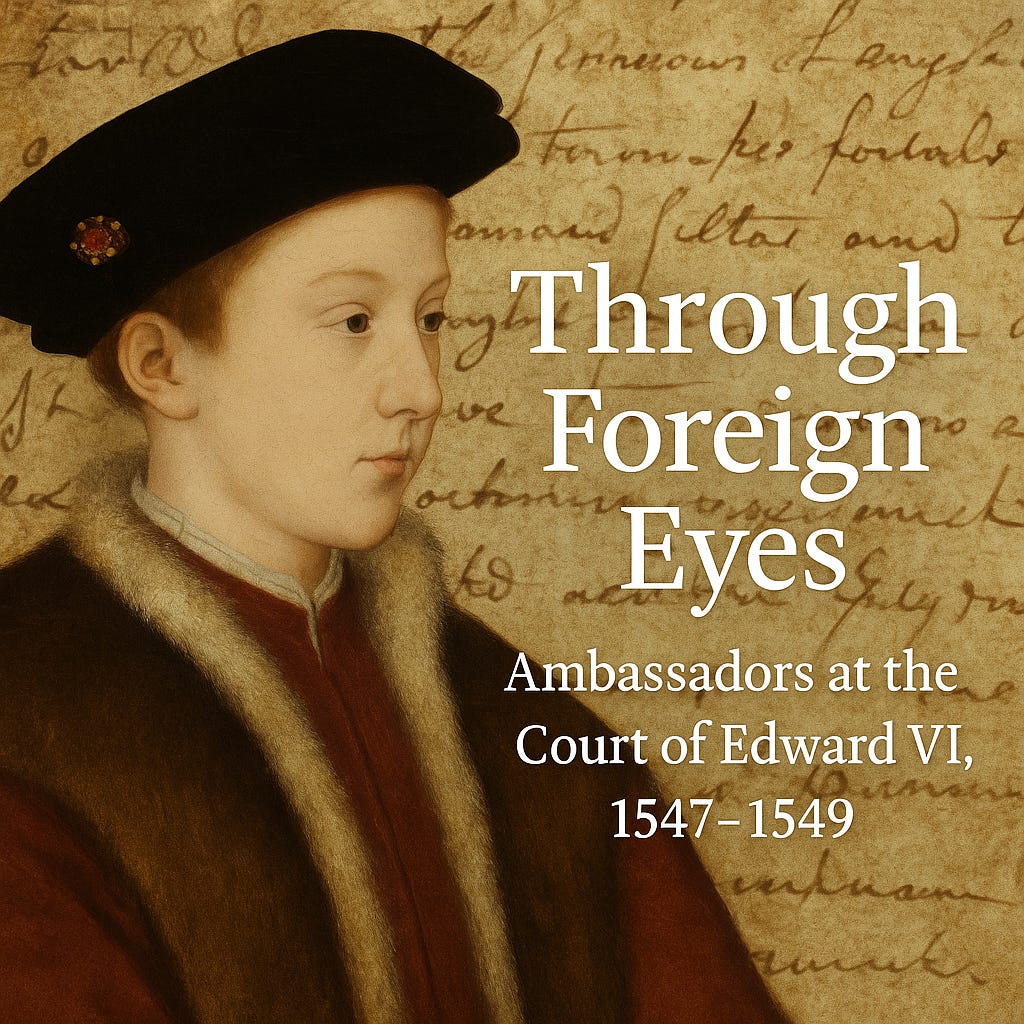
One of the most fascinating ways to study the early reign of Edward VI is not through English chronicles or government papers—but through the eyes of the foreign ambassadors who watched the boy-king’s court unfold day by day. Between 1547 and 1549, these men—imperial, French, Venetian, and occasionally Scottish—sent home detailed, sometimes breathless reports that reveal a court in constant motion. But as with all observers, their words tell us as much about them as about the England they described.
A Kingdom under New Management
When Henry VIII died in January 1547, the world turned its gaze toward England. The nine-year-old Edward now wore the crown, and the ambitious Edward Seymour, Duke of Somerset, stepped forward as Lord Protector. To ambassadors accustomed to the bombastic confidence of Henry VIII, the new regime looked uncertain—a court run by counselors rather than a king.
Reports from François van der Delft (the Imperial ambassador) and Antoine de Noailles (the French envoy) crackle with speculation: Who truly controlled the government? Could Somerset keep peace abroad while asserting authority at home? Their letters oscillate between admiration for England’s military resources and amusement at its internal squabbles.
Personal Bias and Political Purpose
Each ambassador had a purpose—and an agenda. Van der Delft, serving Emperor Charles V, viewed events through a Habsburg lens, often portraying Protestant reform as dangerous radicalism. His descriptions of court sermons, religious changes, and the treatment of Princess Mary (Charles’s cousin) are tinged with outrage. To him, England was a kingdom sliding into heresy, guided by men who used the boy-king as cover for their own ambitions.
De Noailles, on the other hand, represented France’s interest in keeping England unstable and distracted. His dispatches highlight faction, rebellion, and disorder, sometimes exaggerating them to suggest that the Tudor government was crumbling. The truth lies somewhere in between—England was indeed unsettled, but not quite collapsing.
The Power of the Narrative
What these ambassadors produced were stories—daily narratives shaped by personal bias, limited access, and political motive. They were outsiders trying to interpret a language of power that was often performed for their benefit.
When Somerset paraded Edward through London, or when the young king presided at council, the ambassadors saw what they were meant to see: the image of stability and continuity. Yet behind the scenes, the same letters hint at growing resentment from John Dudley and other nobles who would later overthrow the Protector.
Even the reports of Edward himself are revealing. Some describe him as precocious and serious beyond his years; others dismiss him as a puppet. Both portrayals carry truth—but both are filtered through lenses of expectation and ideology.
Reading between the Lines
By comparing these letters with domestic records—the council minutes, proclamations, and private correspondence—we can see where truth and exaggeration meet. The ambassadors, in essence, give us a running commentary on how Tudor England appeared to Europe: a stage on which men like Somerset, Dudley, and the Seymour brothers acted out a drama of reform and rivalry.
Their accounts are invaluable not because they are impartial, but precisely because they are not. They remind us that history is always told through someone’s eyes—and sometimes those eyes belong to a man with a quill, a deadline, and a diplomatic agenda.
A Final Thought
Between 1547 and 1549, England’s ambassadors abroad tried to explain a kingdom redefining itself after the death of a colossal monarch. At home, the ambassadors looking in offered Europe a mirror image: a court brilliant, divided, pious, and proud.
In their words, we glimpse the noise and color of Edward’s reign—the sermons echoing in St. Paul’s, the gossip in Somerset’s chambers, the uneasy smiles of courtiers balancing faith and survival. And while their stories may be skewed, they remain one of the richest, most human ways to understand the fragile beginnings of the Tudor boy-king’s rule.
Rebecca Larson is an independent researcher, writer, and host of the Tudors Dynasty & Beyond podcast. She’s has been researching Thomas Seymour since 2016, and focuses on re-examining his life, loyalty, and legacy in the Tudor court through original documents and more!
colossal monarch, indeed.